Although both deal with businesses, they have very different roles. Understanding what each organisation does and what your company needs to report to them can help you avoid missed deadlines, penalties and unnecessary stress.
In this guide, we explain the difference between HMRC and Companies House in simple terms.
What Is HMRC?
HM Revenue & Customs (HMRC) is the UK government department responsible for collecting taxes and managing certain tax-related responsibilities.
For a limited company, HMRC is mainly concerned with the company's tax affairs.
Depending on your business activities, you may need to deal with HMRC for:
- Corporation Tax
- PAYE and employer responsibilities
- VAT
- Income Tax and National Insurance for directors or employees
- Other business-related taxes
One of the most important responsibilities for a limited company is Corporation Tax.
Your company normally needs to work out how much Corporation Tax it owes based on its taxable profits and pay the amount due to HMRC by the relevant deadline. You will also need to submit a Company Tax Return (CT600) to HMRC.
It is important to remember that paying your Corporation Tax and filing your Company Tax Return are separate responsibilities. Your business needs to do both where applicable.
What Is Companies House?
Companies House is the UK government agency responsible for incorporating companies and maintaining the official register of companies.
Its role is focused on company information and corporate records, rather than collecting tax.
Companies House holds important information about your company, such as:
- Company name
- Registered office address
- Directors
- People with Significant Control (PSCs)
- Share information
- Certain company filings and accounts
A limited company must keep its information up to date and submit required documents to Companies House within the relevant deadlines.
One of the most important annual requirements is filing your annual accounts.
You must also submit a confirmation statement at least once every 12 months, which confirms that key information about your company is correct.
HMRC vs Companies House: What Is the Difference?
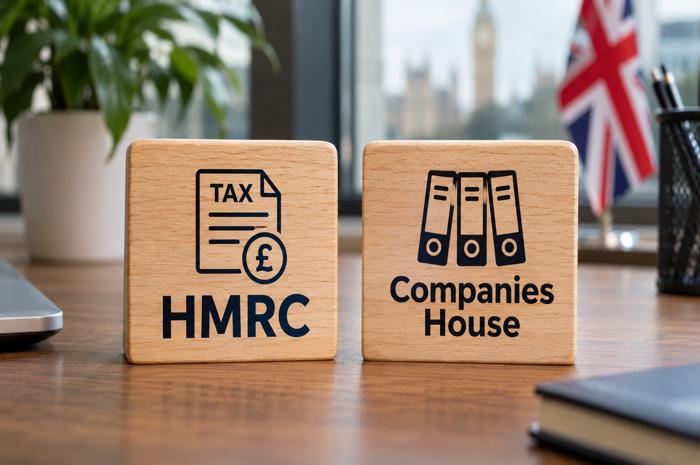
The easiest way to remember the difference is:
- HMRC = tax
- Companies House = company information and records
For example, if you need to deal with your company's Corporation Tax, you are dealing with HMRC. If you need to update your registered office address or file your company's annual accounts, you are dealing with Companies House.
However, there can be some overlap. Your company accounts contain financial information that may be relevant to both organisations, but the information is submitted for different purposes and under different rules.
This is why business owners should not assume that filing something with Companies House automatically means they have met their HMRC obligations - or vice versa.
The table below highlights the key differences between HMRC and Companies House, including their responsibilities, filing requirements and deadlines:
| HMRC | Companies House | |
| Primary role | Tax collection and administration | Company registration and statutory records |
| Main filings | Company Tax Returns (CT600) | Annual accounts and confirmation statements |
| Payments | Corporation Tax, VAT and PAYE where applicable | Filing fees where applicable |
| Key deadlines | Corporation Tax payment generally 9 months and 1 day after the accounting period ends; CT600 generally within 12 months | Annual accounts generally 9 months after the financial year ends |
| Other responsibilities | VAT registration, payroll and tax compliance | Updating company details, directors and PSC information |
What Does a Limited Company Need to File?
Your company compliance obligations depend on factors such as its size, activities, employees and VAT registration. However, common requirements include:
With Companies House
Your company may need to:
- File annual accounts
- Submit a confirmation statement
- Keep company information up to date
- Report changes to directors or PSCs
- Report changes to the registered office
- Maintain appropriate company records
With HMRC
Your company may need to:
- Register for Corporation Tax
- File a Company Tax Return
- Pay Corporation Tax
- Operate PAYE if it employs people
- Register for VAT if required or chosen
- Submit relevant payroll and VAT returns
Missing one organisation's deadline does not remove your responsibility to the other.
Why Are the Deadlines Important?
Both HMRC and Companies House have deadlines, and missing them can lead to penalties.
Companies House can issue penalties when accounts are filed late. HMRC can also charge penalties and interest when tax returns or payments are late.
The deadlines are not necessarily the same. This is one of the most common areas of confusion for company directors. A business may file its accounts with Companies House on time but still have a separate HMRC deadline to meet.
Keeping a clear calendar of your company's filing and payment dates can help prevent avoidable problems.
Can an Accountant Help?
Managing company accounts, tax returns and filing deadlines can be time-consuming, particularly if you are focused on running and growing your business. An accountant can help you understand which obligations apply to your company, prepare accounts and tax returns, calculate tax liabilities and keep track of important deadlines. Professional support can also help reduce the risk of errors and give you greater confidence that your business is meeting its responsibilities. However, you can legally file your own returns as a Director and filing software such as Easy Digital Filing will help you meet your compliance requirements.
Conclusion:
HMRC and Companies House both play an important role in the UK business system, but they have different responsibilities. HMRC deals primarily with your company's tax obligations, while Companies House deals with company registration, corporate information and statutory filings.
As a limited company director, it is your responsibility to make sure your business meets the requirements of both organisations.
Understanding the difference is a simple but important step towards keeping your company compliant.
If you are unsure about what your company needs to file, when something is due, or whether you have an HMRC or Companies House responsibility, getting professional advice can help you stay on track and avoid unnecessary penalties.